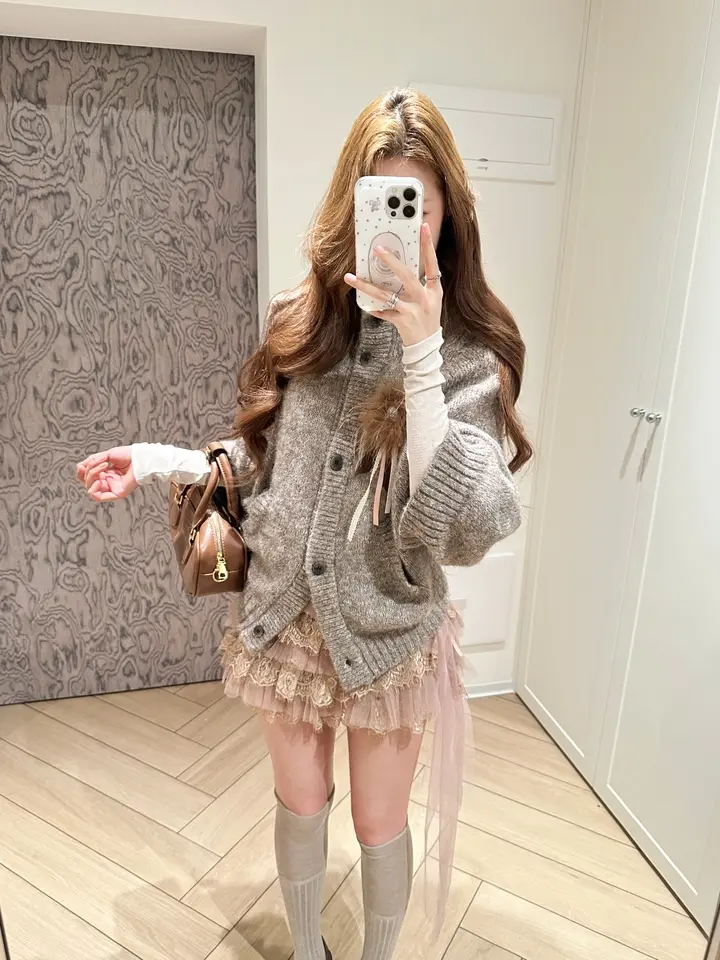
A medium from an independent Guangzhou studio and a medium from a US mall brand are not the same garment measured against a shared ruler. They are two different guesses about the body underneath — and the Chinese one is usually guessing narrower.
That gap is where cross-border returns come from. Not bad design, not a factory error — just a label letter doing a job it was never built to do.
Do Chinese clothes run small? Usually, yes.
Chinese indie sizing tends to run about one size tighter than the US/UK equivalent, and the difference concentrates exactly where you'd least want slack to disappear: the bust, the shoulders, the upper arm. Many of these labels draft for a slimmer, shorter-torso frame, so a top that clears your bust can still bind across the back, and a blazer that buttons can still pull at the shoulder seam. Sleeves land a touch short. Waistlines sit high. None of this is a defect — it's a different default body, and once you know it's there, it stops ambushing you.
Structured pieces are the strictest offenders. Tailored shirts, set-in sleeves, anything woven and architectural has no stretch to bail you out. A relaxed camisole forgives half a centimeter; a suit blouse with a built shoulder does not.

Stop reading the letter. Read the chart.
The single most useful habit for buying Chinese fashion: treat "S / M / L" as decoration and go straight to the centimeter chart on the product page. Every serious listing carries one — bust, waist, hip, shoulder, length, often sleeve, all in cm. That chart is the truth. The letter beside it is just shorthand, and shorthand lies across brands.
Two mediums from two different studios can sit six centimeters apart at the bust. The chart is the only thing that tells you which medium is actually yours. Read it every single time, even for a brand you've bought before — indie labels re-draft patterns between drops more freely than big houses do.
Measure yourself in four numbers
You need a soft tape and about ninety seconds. Measure over a thin layer, not over a sweater, and keep the tape level — don't let it dip at the back.
Bust: around the fullest point, tape flat under the arms. Waist: the narrowest part of your torso, usually just above the navel. Hip: the fullest point of your seat, feet together. Shoulder: across the back, from the bony point of one shoulder to the other. Shoulder is the number cross-border shoppers skip and then regret — it's the one measurement a garment can't stretch or belt its way around.
Hold your four numbers against the chart. If you land between two sizes, or you're at the top of a range, size up. You can take a seam in; you can't add fabric you didn't buy.

Chinese size conversion, honestly
The rough working rule: a Chinese label's M often maps closest to a US XS–S, and an L to a US S–M. But treat that as a starting suspicion, not a formula. Numeric Chinese sizing (155/80A, 160/84A) reads as height/bust in cm plus a body-type code — genuinely useful once you decode it, but you still confirm against the garment's own cm chart. Every reliable conversion ends at the same place: your measurements versus the product's measurements. Browse the full tops for women → range and you'll see the charts vary label to label — that variance is exactly why the letter can't be trusted alone.
When to size up — and when you can relax
Fabric decides how much the numbers matter. A ribbed knit, a jersey, anything with elastane will move with you, so a snug chart reading is usually fine and often intended. Woven cotton, linen, taffeta, and structured tailoring have no give — here, if you're between sizes, always take the larger. Dresses are the highest-stakes call because bust, waist, and hip all have to land at once; check all three against the chart before you commit, and browse dresses for women → with the tape already in hand.
Do this once and it becomes reflex. Four numbers, the cm chart, size up when the fabric won't stretch — and the return anxiety mostly disappears. See what just landed → and put the method to work.